How the Pockets Full of Why series works, and what we hope it does for your family.
Kids notice everything
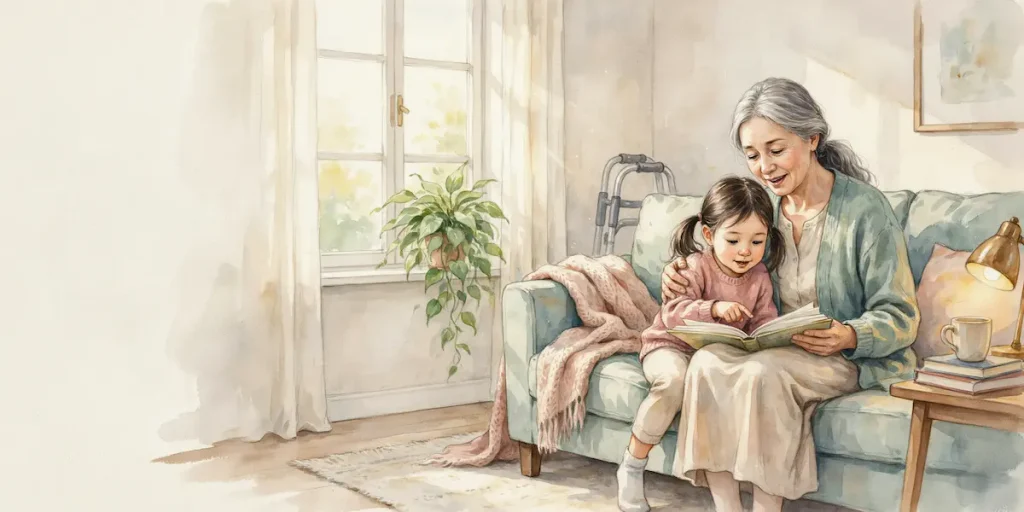
A walker shows up in Grandma’s living room. Grandpa starts asking you to repeat things. Someone who used to lift you up now stays in the chair.
Children see all of it. They just don’t have the words for it yet, so the questions come out sideways. Why does Grandma walk funny now? Is she going to break? Did I do something?
Most grown-ups freeze a little at those questions. Not because they don’t care, but because the honest answer feels too big and the easy answer feels like a lie. So we say “she’s fine, sweetie” and change the subject, and the child walks away with the worry still in their pocket.
That’s the gap these books were made to fill.
What Pockets Full of Why is
Pockets Full of Why is a picture book series about the big questions little kids ask when a grandparent gets older.
Each book takes one real change, the kind of thing that actually shows up in families, and gives it a story. A walker. A hearing aid. A memory that skips. A house that has to change, or a grandparent who has to move.
The books are written to be read out loud, at bedtime or on the couch, by a grown-up and a child together. That’s on purpose. These aren’t books a child reads alone and puts back on the shelf. They’re books that start a conversation and then stay in the room while you have it.
How each book works
Every title in the series follows the same shape.
A child notices something. Not a crisis. A change. The thing the child in your house has probably already spotted.
The child asks. Out loud, plainly, the way kids actually ask.
A grown-up answers honestly. No fairy tale, no brush-off. The answer is true, it’s simple, and it’s calm. This is the part we work hardest on, because it’s the part parents borrow.
The child gets to help. Not as a chore, but as a way back into the relationship. Kids who feel useful feel less scared.
The book lands somewhere steady. Something changed. Something didn’t. The part of Grandma that loves you is still all the way there.
That last beat matters more than anything else in the book. Children can handle a lot of change if you tell them clearly what is not changing.
What we want these books to do for children
We want a child to close the book with less fear than they opened it with.
Aging looks scary to a four-year-old mostly because it’s unexplained. Once a walker has a name and a job, once a hearing aid is just a tool like glasses, the mystery drains out of it and the fear usually goes with it. Curiosity is a much better place for a kid to stand than worry.
We also want children to stay close. When kids don’t understand what’s happening to a grandparent, they pull back. They get quiet around the hospital bed, they stop climbing into the chair, they stop visiting the way they used to. That distance is a real loss, for the child and for the grandparent both. A story that makes the change ordinary keeps the door open.
What we want them to do for parents
This is the part people don’t expect from a picture book.
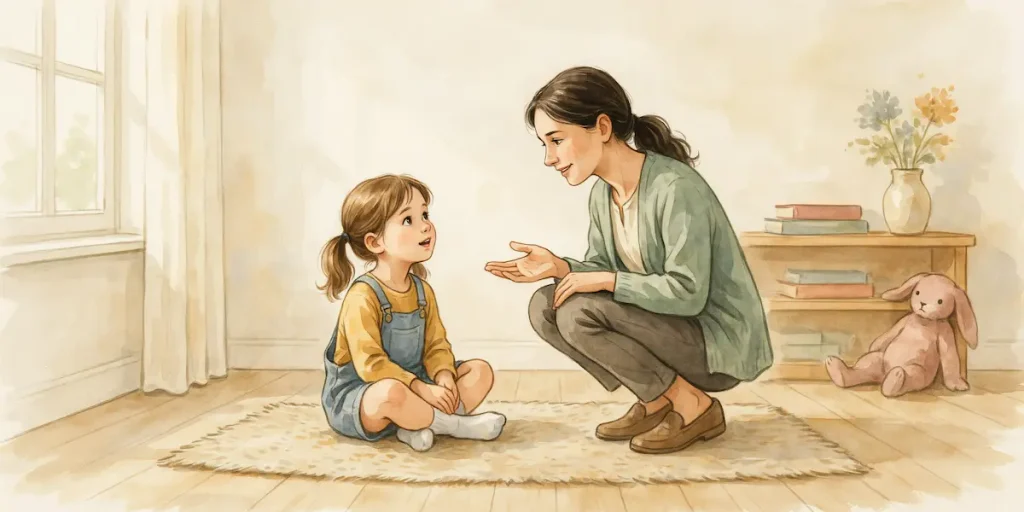
Parents are the ones actually caught in the middle. You’re managing your own parent’s aging, often while working, often while sad about it, and then a six-year-old asks you a question you don’t have a script for.
So these books are written for two readers at once. The child gets the story. The grown-up gets the words.
When you read a Pockets Full of Why book out loud, you’re rehearsing. You’re hearing a calm, honest, age-right way to say a hard thing, and you’re saying it in your own voice while your child watches your face stay relaxed. Next week, when the question comes out of nowhere in the car, you already know how it goes.
The books also give you an opening. A lot of families don’t talk about aging until something breaks. A picture book is a low-stakes way to start early, before anyone is in the emergency room, back when it’s still just a story about somebody else’s grandma.
And they make room for grandparents, too. Plenty of older adults feel embarrassed about the walker or the hearing aid, especially around their grandchildren. It helps enormously to have the child arrive already understanding. Some of the best moments happen when the grandparent is the one doing the reading.
The series so far
Grandma Rosie and the Silver Walker is the first book. A granddaughter comes to visit after Grandma Rosie has a fall and finds a new silver walker in the house. Grandma Rosie calls it her helper, a little like training wheels, and the two of them do her exercises together. It ends where every book in this series ends: the part of her that loves you doesn’t change.
Ways to read it
Every title comes in a few different forms, because families use these books in different ways.
The picture book. The print edition, on Amazon. This is the one for the couch and the bedtime read, the copy that gets a little worn out.
The coloring book on Amazon. A print companion to the story, with scenes from the book to color in. Coloring is how a lot of little kids keep thinking about something after the talking is done. Don’t be surprised if the questions come back out while they’re working on it.
The printable coloring PDF. The same coloring pages as an instant download. Print a page, print it again, print ten copies for a classroom or a waiting room or the drive to Grandma’s house. Useful when you want the pages on hand and don’t want to wait for shipping.
The online flipbook. The full-color book, right here on the site, readable on a phone, tablet, or laptop. This one earns its keep when the grandparent lives far away. You can pull it up on a video call and read it together from two different houses, which is not a small thing when visits are hard to come by.
What’s coming
We’re writing more, because families kept telling us which question came next.
Hearing that fades. Memory that slips. A grandparent who moves in, or moves out, or into a place with a different name. Hands that shake. The day someone stops driving.
Different questions, same promise every time. Tell the truth, keep it gentle, and end with what stays.